Job Scheduling Policy
This page explains how the clusters are shared and why the limits work the way they do. For the specific numbers — QoS walltimes, per-group resource caps, and array limits — see Job Limits & QoS.
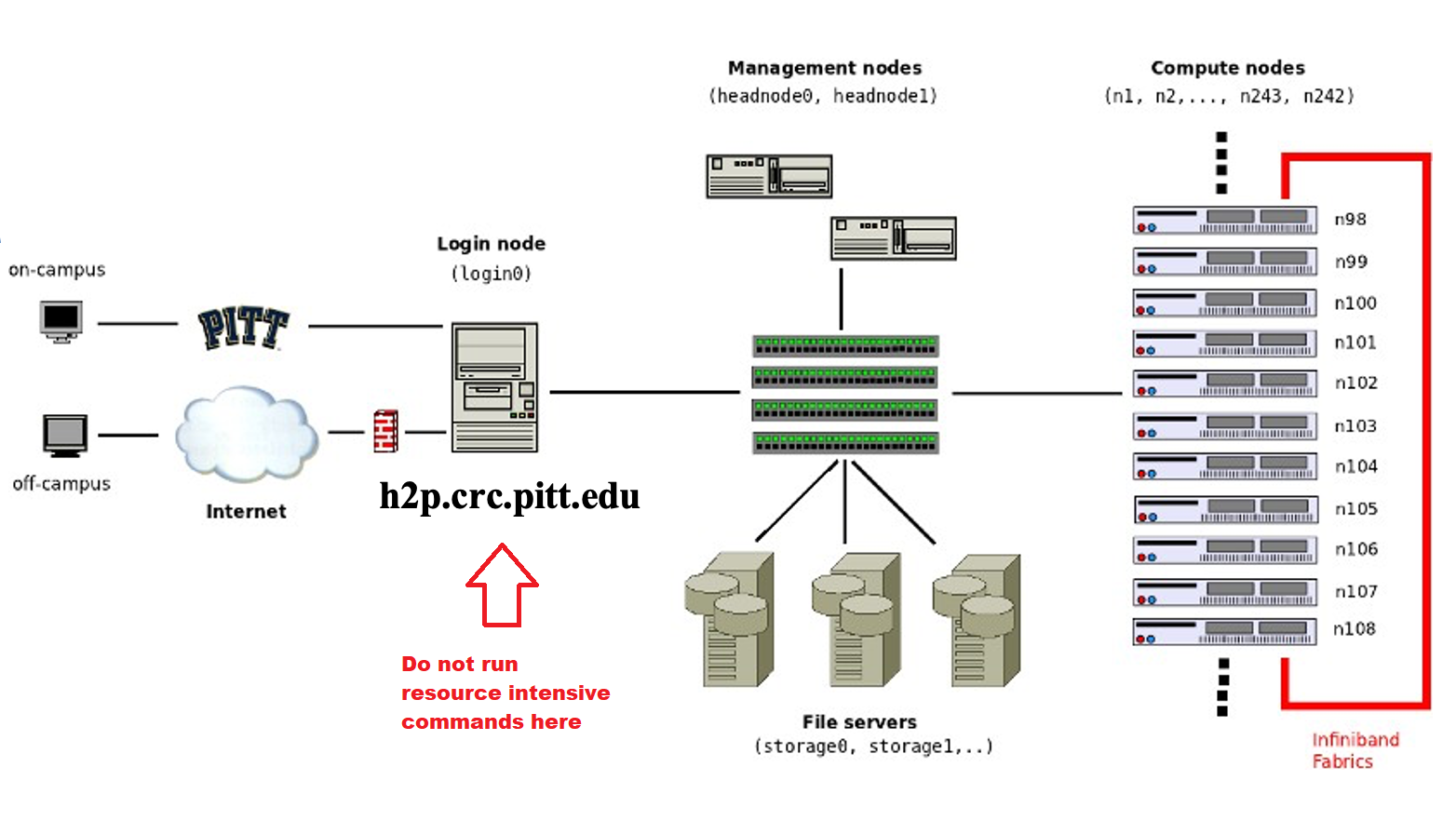
Login nodes are for light, interactive work only
Many users share the login nodes of the H2P and HTC clusters. They're the gateway for interactive work like editing code and submitting or checking jobs. Running computation directly on them slows everyone down, so that work belongs in an interactive session or a batch job.
To preserve the interactivity of the shared environment, per-user limits are enforced via cgroups (currently 1 core and 8 GB of memory per user). These apply across all of your processes on the login node. When the node's resources are exhausted, you may be unable to log in until usage drops. Resource-intensive processes on the login nodes may be killed at any time.
Don't get banned!
CRCD reserves the right to revoke cluster access from any user who repeatedly causes login node slowdowns with work that belongs on the compute nodes.
Jobs are subject to priority queueing
The Slurm scheduler gives every group and every user within a group a fair opportunity to run work. When resources are busy, jobs wait in the queue and are started in order of a computed priority. CRCD uses Slurm's multifactor priority, so a job's priority is the weighted sum of several factors:
- Age — how long the job has been eligible in the queue. Longer waits earn more priority, up to a maximum reached at 7 days.
- Job Size — how much the job requests. On most clusters this favors smaller jobs (see the note below).
- QoS — a factor based on the walltime tier, normalized so the shortest tier
(
short) scores highest. - Fair Share — usage-based: groups that have used less of the cluster recently are prioritized over heavy users.
- Partition — a large weight that gives investor and community-owned partitions their higher-priority access to the hardware they contributed.
The weights differ by cluster. The current values:
| Factor | SMP | HTC | MPI | GPU |
|---|---|---|---|---|
| Age | 2000 | 100 | 2000 | 2000 |
| Job Size | 2000 | 4000 | 4000 | 2000 |
| QoS | 2000 | 400 | 2000 | 2000 |
| Fair Share | 3000 | 100 | 3000 | 3000 |
| Partition | 50000 | 50000 | 50000 | 50000 |
Job Size favors small jobs on most clusters
SMP, HTC, and GPU run with PriorityFavorSmall, so on those clusters a
smaller job earns a higher Job Size factor — a quick, modest job can jump
ahead of a large one. MPI is the exception: there, larger jobs are favored.
Because the scheduler also uses backfill, a small, short job can start
ahead of a larger queued job whenever doing so won't delay the higher-priority
job's start.
Checking a job's priority
Use sprio to see the priority breakdown for a pending job:
[gnowmik@login1 mocvnhlysm_GPU_8L40S-8C]$ squeue -M gpu -u $USER
CLUSTER: gpu
             JOBID PARTITION     NAME     USER ST       TIME  NODES NODELIST(REASON)
           3347015     rtx6k   gpus-1  gnowmik PD       0:00      1 (Resources)
[gnowmik@login1 mocvnhlysm_GPU_8L40S-8C]$
[gnowmik@login1 mocvnhlysm_GPU_8L40S-8C]$ sprio -M gpu -j 3347015
          JOBID PARTITION   PRIORITY       SITE        AGE  FAIRSHARE    JOBSIZE  PARTITION        QOS                 TRES
        3347015 rtx6k          13607          0          0       1123       1985      10000        500
A job may show a pending reason of Priority, meaning higher-priority jobs are
ahead of it; it will start once it has risen far enough.
Walltime extensions are generally not granted
It's up to you to estimate a job's needs (through benchmarking and any necessary optimization) and set the memory, CPU, and time accordingly before submitting. This keeps queueing fair and ensures resources come back to the community within a reasonable time. Choose a QoS walltime tier that comfortably fits your job, since extensions to a running job's walltime generally won't be granted.
Exceeding usage limits will cause job pending status
After submission, a job can sit in a pending (PD) state for several reasons,
including asking for more than your group's share at once. The pending reasons and
how to resolve each are documented alongside the limits themselves on the
Job Limits & QoS page.
Related
-
The actual limits
QoS walltimes, per-group CPU/GPU/memory caps, and array limits.
-
How usage is charged
Service Units and the billing weights per cluster.
-
Work interactively
Keep heavy work off the login nodes with an interactive session.